PRP Stretch Mark & Scar Rejuvenation
Renew Your Skin's Appearance
Explore advanced microneedling and PRP-assisted options for improving the appearance of stretch marks and selected scars.
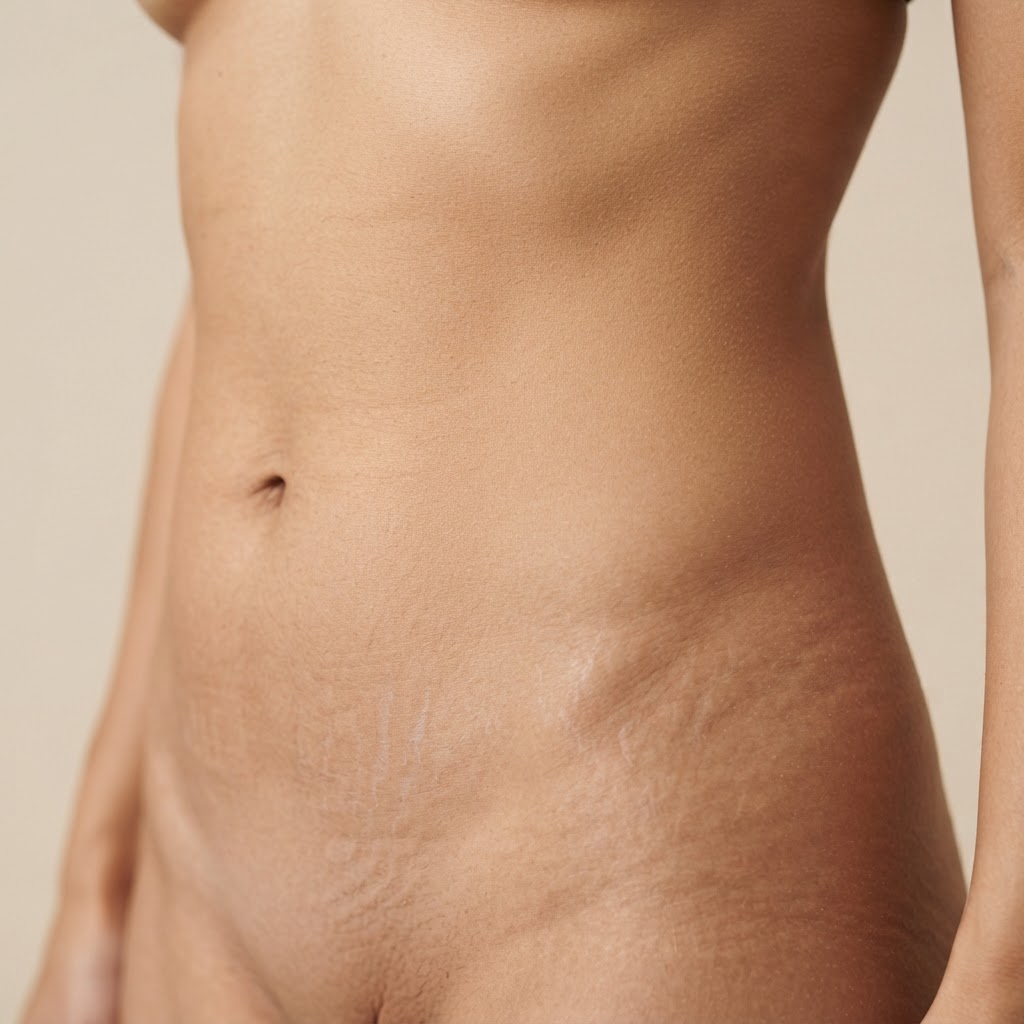
Understanding Stretch Marks
Stretch marks form when the skin is stretched quickly — during a growth spurt, pregnancy or rapid weight change — and the dermal connective tissue cannot keep pace. That connective tissue is the collagen and elastin network that gives skin its support, so when it is disrupted the skin heals with a change in structure and texture rather than a surface mark.
They generally follow a predictable pattern. Early on they often appear red or purple; over time they fade toward white or silver and feel softer or slightly depressed compared with the surrounding skin. Scars behave similarly in some ways: they are also structural repairs, which is why the goal of treatment is improvement in appearance — not erasure.
Striae Rubrae — Red or Purple Stretch Marks
Newer marks where the skin is still actively remodeling. These are generally considered more responsive to treatment than mature marks, though response still varies.
Striae Albae — White or Silver Stretch Marks
Matured marks that have lost pigment, with a softer or slightly depressed texture. Improvement is usually more limited and sometimes minimal.
Selected Mature Scars
Some older scars — including certain surgical or injury scars — may also be assessed, depending on their location, type and how they have healed.
The age of a stretch mark matters. Marks that are still red or purple behave differently from ones that have already matured to white or silver, and a mature scar in the same area may behave differently again. Your consultation is where that is sorted out.
Common Treatment Areas
Stretch marks and scars are assessed area by area, because the skin behaves differently across the body. Larger areas may be treated in segments across separate visits for comfort and safety.
Abdomen
The most commonly treated area, often treated in sections for comfort.
Thighs
Inner and outer thigh marks, frequently assessed together with other areas.
Hips
Marks related to growth, pregnancy or weight change across the hip and flank.
Upper Arms
Marks on the inner or upper arm, which may involve a smaller treatment area.
Other Appropriate Areas
Breasts, buttocks and selected single scars may be evaluated during your consultation.
How Treatment Works
Microneedling creates controlled micro-injuries across the treatment area, which stimulates a controlled wound-healing response and a period of collagen remodeling in the weeks that follow.
PRP, prepared from a small sample of your own blood, contains platelet-derived growth factors. It may be considered as an adjunct to microneedling to support the skin's repair process, although the additional benefit of PRP beyond microneedling alone remains uncertain.
The goal is improvement in texture and appearance. It is not complete elimination of the marks, and it is not skin tightening or a change in the underlying tissue.
About the evidence
Research on microneedling and PRP for stretch marks is still developing, and study results are mixed. This is an elective, appearance-focused treatment — not a scar-removal procedure — and it is not intended to diagnose, treat, cure or prevent any disease.
What to Expect
Five simple stages, from first assessment through follow-up evaluation.
Consultation & Skin Assessment
We review the age, location and appearance of your stretch marks or scars, along with your skin and history.
Individualized Treatment Plan
You receive a plan covering the areas to be treated, the sessions considered, costs and realistic expectations.
Treatment Session
A small blood sample is prepared, then microneedling with PRP is performed. Topical anesthetic is used to improve comfort, and larger areas may be treated in segments.
Recovery
You leave with aftercare guidance. Redness, tenderness and possible swelling are expected for a short period while the skin settles.
Follow-Up Evaluation
A follow-up visit reviews how the skin has responded using consistent photographs, and adjusts the plan if needed.
Results & Limitations
Outcomes vary, and several factors influence how much change is possible: the age of the stretch marks, your skin characteristics, the type of scar, the area treated, and how your own skin responds.
Newer red or purple marks are generally considered more responsive than older white or silver marks, which may improve only minimally. Improvement builds gradually over weeks to months and is usually measured across a series of treatments.
Complete removal of stretch marks is not something this treatment can promise, nor is skin tightening. Where a different approach may be more appropriate, your provider will say so.
Results vary
Individual results vary and are not guaranteed. Some clients see limited or no improvement, and expectations should stay modest. Consistent photographs are used to track change objectively rather than judging from memory.
Recovery & Aftercare
Expect redness, tenderness and a warm, sunburn-like sensation in the treated area for a day or two, with possible swelling, pinpoint marks or a feeling of tightness. Most clients return to normal activities quickly, though a treated body area may feel sensitive for a short time.
Sun protection matters while the skin recovers, and you will be asked to pause strenuous exercise, saunas and active skincare ingredients for a short period.
Because larger areas may be treated in segments, aftercare is individualized to the area treated. Your provider will give you written instructions and explain when to expect visible change.
Frequently Asked Questions
PRP, microneedling and aesthetic treatments are available at our Rancho Cordova clinic, serving clients across Sacramento, Folsom, Roseville and surrounding communities. All treatments require an in-person consultation and clinical evaluation to determine candidacy.
Need Help Deciding?
General questions about services or pricing?
Want personalized treatment recommendations?
Not sure whether a regenerative approach is right for your stretch marks or scars? Meet with a provider for a personalized assessment.
$99 applied toward an eligible treatment when you proceed within 30 days.
Request a consultation to review your stretch marks or scars and the options available. Our team will contact you to finalize scheduling.